THE RISK-AESTHETIC FRAMEWORK
How action sports integrate risk, aesthetics, and ethics to create meaningful high-performance sport

"Risk + Aesthetics = Value"
Participants make sense of experiences based on the blend of risk involved and the opportunity to do something creative, stylish, or innovative.
What is the Risk-Aesthetic Framework?
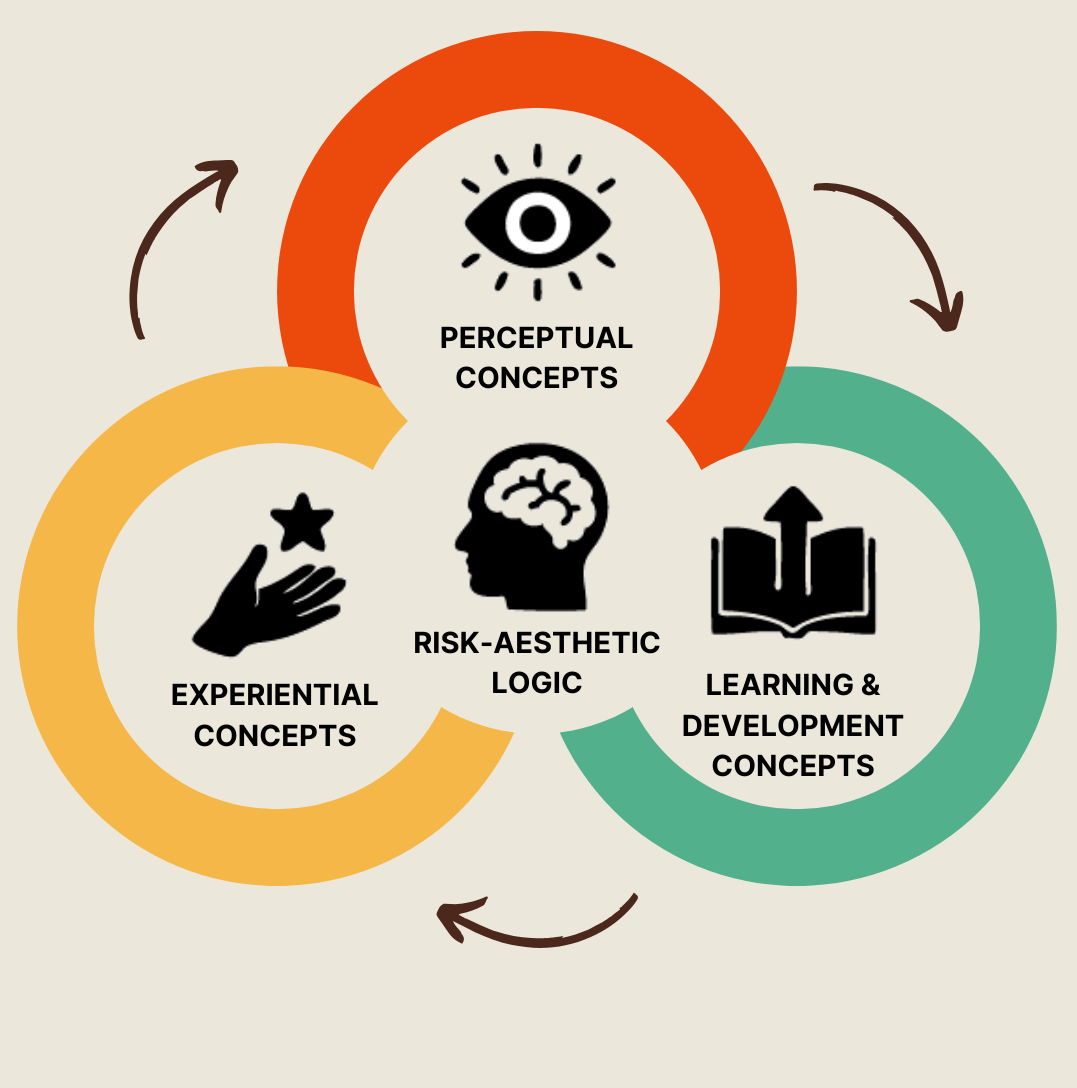
The Risk-Aesthetic Framework: Three interconnected dimensions that work together to generate meaningful sport experiences
The Risk-Aesthetic Framework reveals how high-performance action sports practitioners make decisions and create value through an integrated approach combining risk calibration, aesthetic expression, and ethical judgment.
Unlike traditional sport’s primary focus on measurable outcomes (times, scores, rankings), action sports operate through what this research terms “risk-aesthetic logic”—where participants evaluate experiences based on the combination of risk involved and the opportunity to create something stylistically unique or “cool.”
Think of the framework like a recipe: Each ingredient matters, but they combine to create something greater than the sum of their parts. When all elements work together, they generate experiences practitioners call “stoke”—valued more highly than competitive success.

Section 2: The Core Principle
Participants make judgments that are pragmatic with a deep care for style and elegance.
These judgments are made both individually and collectively by communities of practice. This creates a nuanced, never black-and-white approach to determining what makes sport worthwhile.
The result? Shared progression emerges as a core value—what’s good for the individual is good for the community and the sport in general. What this means in practice:
Individual uniqueness within strong community bonds –
Celebrating personal style while staying deeply connected
Deep environmental connection
Feeling part of something bigger than yourself, with care for sustainability
Holistic personal growth
Developing as a whole person, not just an athlete
Ability to create positive cultural change
Taking action to build the kind of community you want
Section 3: The Three Dimensions
THE THREE DIMENSIONS EXPLAINED
The Risk-Aesthetic Framework comprises three interconnected dimensions. Each dimension contains specific concepts that emerged from research with 74 elite athletes, coaches, judges, and event professionals.

EXPERIENTIAL CONCEPTS
The “Stoke” Family
These concepts describe the lived experiences most valued by practitioners
—what makes participation meaningful moment-to-moment.
-
What it is:
Stoke is the most valued experience in action sports—encompassing fun, play, joy, achievement, and gracefulness. Participants consistently rate stoke higher than winning.
Participant voice:
> “Stoke is everything. You can podium and have zero stoke, and that’s a shit day. Or you can finish last but have the best session of your life—that’s what you remember.” — Participant 3d
Why it matters:
Stoke represents the internal goods of practice—the intrinsic rewards that make the sport worth doing regardless of external outcomes. When athletes lose stoke, they lose connection to why they participate.
In practice:
Watch for moments when riders express pure joy or satisfaction regardless of their run’s technical outcome. Stoke is visible in body language, peer celebrations, and post-run reactions that transcend competitive results.
-
Description teWhat it is:
Shared stoke occurs when one person’s stoke spreads to others in a session. It’s the contagious nature of positive experiences within a community of practice.
Participant voice:
> “When someone’s having fun, everyone’s having fun. The energy just shifts. You can feel it.” — Participant 3n
Why it matters:
Shared stoke demonstrates that value in action sports isn’t zero-sum. One person’s success or joy enhances rather than diminishes others’ experiences. This creates collaborative rather than purely competitive dynamics.
In practice:
Observe how riders react to each other’s runs. Genuine celebration of competitors’ performances—even from rival nations—reveals shared stoke in action.xt goes here
-
What it is:
The stoke train is a collective phenomenon where progression compounds—one rider’s breakthrough inspires others to land new tricks, creating a wave of achievement and energy.
Participant voice:
> “That situation where it just goes off, one person lands something new…and loads of other people all of a sudden also land the new thing. Everyone’s feeding off each other.” — Participant 3o
Why it matters:
The stoke train reveals that individual performance is deeply collaborative. What appears to be solo athletic achievement emerges from shared embodied presence and collective commitment to progression.
In practice:
Look for sessions where energy escalates—multiple riders pushing limits in succession, visible excitement building, and a palpable shift in the atmosphere. This is the stoke train in motion.

PERCEPTUAL CONCEPTS
How You See and Feel
These concepts describe unique perceptual capacities practitioners develop—ways of experiencing their own performance and witnessing others that are distinctive to action sports.
-
What it is:
Inside-out performance describes the capacity to think and do simultaneously—kinesthetically feeling actions while visualizing how they look, all in real-time while performing under risk.
Participant voice:
> “You’re feeling what you’re doing but also seeing it in your mind’s eye. You know if it looked good before you land.” — Participant 3m
Why it matters:
This embodied attunement enables split-second risk-skill-style calibration that cannot be replicated by external coaching or AI systems. It’s the foundation of creative decision-making under uncertainty.
In practice:
Inside-out performance develops through extensive practice and cannot be shortcut. Coaches with their own embodied practice backgrounds can help athletes develop this capacity, but it must be inhabited, not taught algorithmically.
-
What it is:
Outside-in viewing is the capacity of competent observers to experience visceral, somatic responses to performances—“mind-surfing” or “feeling with” the performer through embodied expertise.
Participant voice:
“When you watch someone at your level or better, your body responds. You feel it. Sometimes you’re almost there with them.” — Participant 3c
Why it matters:
Outside-in viewing creates deep appreciation for individual uniqueness in how people handle risk and express style. It’s why peer recognition matters more than external validation—competent witnesses understand the achievement in ways outsiders cannot.
In practice:
Judges with relevant embodied expertise don’t just score performances—they experience them somatically. This competent witnessing is essential for authentic evaluation of style, commitment, and innovation that transcends measurable metrics.
-
What it is:
Positive insignificance is a perceptual stance where practitioners recognize their smallness compared to nature’s power and experience this awareness as positive and freeing rather than diminishing.
Participant voice:
“You realize you’re tiny against the mountain, and somehow that’s…comforting? You’re just one small part of this massive thing.” — Participant 3k
Why it matters:
Positive insignificance cultivates humility and environmental connection. It generates ecological consciousness and sustainable relationships with natural environments—not as resources to control but as partners to work with respectfully.
In practice:
This perceptual stance manifests in how athletes discuss conditions, respect weather/terrain, and maintain care for environments. In skateboarding, it extends to heightened awareness of broader ecological consequences and activism.

LEARNING & DEVELOPMENT CONCEPTS
How You Grow
These concepts describe how practitioners make sense of experiences, transmit knowledge, and develop both individually and collectively.
-
What it is:
Epic moments are life-defining breakthrough experiences where multiple framework elements converge—risk, aesthetics, community, environment—creating transformative performances that become cultural waypoints.
Participant voice:
“There are sessions you’ll remember your whole life. They become part of who you are, part of the community’s story.” — Participant 3a
Why it matters:
Epic moments generate meaning that transcends competitive outcomes. They anchor identity, create collective memory, and transmit values across generations. Athletes often remember epic moments more vividly than medals.
In practice:
Epic moments aren’t necessarily contest-winning performances. They’re recognized by the community as culturally significant—the stories that get told and retold, shaping what the sport means.
-
What it is:
Creative story-based learning is the preferred method for sense-making and knowledge transmission in action sports. Practitioners share experiences through narrative (verbal and visual) that connects technical how-to with values, identity, and community ethics.
Participant voice:
“You learn from stories—how someone approached a feature, what they were thinking, what went wrong or right. That’s how knowledge moves.” — Participant 3h
Why it matters:
Story-based learning is dialogical and relational. It transmits not just technique but the cultural logic of when, why, and how to take certain risks or pursue specific aesthetics. It cannot be replaced by algorithmic information delivery.
In practice:
Watch for how athletes debrief sessions, share footage, and explain their decision-making. These narratives teach risk-aesthetic logic more effectively than external instruction because they integrate embodied experience with cultural values.
Section 4: How the Mechanisms Work
THE FOUR HIDDEN MECHANISMS
-
![Geometric drawing of an outline square with sections divided by vertical, horizontal, and diagonal lines.]()
M1: RISK-AESTHETIC ATTUNEMENT (Inside-Out Performance)
What it is: Embodied capacity for real-time integration of risk assessment, skill execution, and aesthetic expression through kinesthetic awareness.
How it works: Practitioners develop somatic intelligence that enables simultaneous feeling and visualizing of movement, allowing creative decision-making under uncertainty that adapts to dynamic conditions.
Why it matters: This mechanism enables the “think and do simultaneously” capacity that generates stoke. It cannot be taught externally—it must be cultivated through practice.
-
![Geometric drawing of an outline square with sections divided by vertical, horizontal, and half circle lines.]()
M2: COMPETENT WITNESSING (Outside-In Viewing)
What it is: Capacity of observers with relevant embodied expertise to experience visceral somatic responses to performances, “feeling with” performers through shared practice backgrounds.
How it works: When competent witnesses observe performances at or above their level, they experience bodily reactions—increased heart rate, micro-movements, mental rehearsal—that create deep appreciation for individual uniqueness in handling risk and expressing style.
Why it matters: Competent witnessing validates achievement in ways external observers cannot. It creates community bonds and transmits standards of excellence through embodied recognition rather than abstract criteria.
-
![M3: BREAKTHROUGH CONVERGENCE (Epic Moments)]()
M3: BREAKTHROUGH CONVERGENCE (Epic Moments)
What it is: Transformative experiences where risk-aesthetic attunement, competent witnessing, optimal environmental conditions, and community presence converge to create performances that become cultural waypoints.
How it works: Epic moments emerge when multiple framework elements align—the right conditions, the right community, personal readiness, and collective energy. They cannot be manufactured but can be cultivated.
Why it matters: Epic moments generate lasting meaning and collective memory. They anchor identity, transmit values, and create stories that shape what the sport means across generations.
-
![Geometric drawing of an outline square with sections divided by vertical, horizontal, and diagonal lines.]()
M4: NARRATIVE TRANSMISSION (Creative Story-Based Learning)
What it is: Dialogical, relational process where practitioners share experiences through stories (verbal and visual) that connect technical knowledge with cultural values, ethics, and community belonging.
How it works: Knowledge moves through the community via narratives that embed technique within meaningful contexts. Stories transmit not just “how” but “when,” “why,” and “for whom”—the cultural logic of risk-aesthetic practice.
Why it matters: Narrative transmission maintains cultural coherence and standards of excellence without institutional control. It’s how communities sustain internal goods across time and through commercialization pressures.




Section 5: Two Ways of Understanding Sport
COMPARING APPROACHES: TRADITIONAL VS. RISK-AESTHETIC LOGIC
The Risk-Aesthetic Framework reveals a fundamentally different approach to high-performance sport than traditional paradigms. This isn’t about “action sports good, traditional sport bad”—it’s about recognizing distinct cultural logics that value different things.
Important: These are tendencies, not absolutes. Some traditional sport practitioners share elements of risk-aesthetic logic, and action sports face pressures toward traditional metrics-driven approaches.
Traditional Sport Logic
Rule-based competition
Opponent-focused
Numbers-driven success (times, scores, rankings)
Hierarchical achievement
Individual excellence
Maintained joy requires effort
(often realized late in career)
External rewards (medals, records, fame)
Body as machine to optimize
Decisions based on what gets results
Measurable outcomes
Control and use environment
Impressive spectacle
Sport integrity = follow rules
Business-focused, everything for sale
Risk-Aesthetic Logic
Risk-aesthetic opportunity with care for style
Environment and community-focused
Stoke and style-driven fulfillment
Shared progression and individual celebration
Individual uniqueness within community bonds
Joy actively maintained as essential
(recognized early)
Internal rewards (personal growth, connection, stoke)
Mind and body as integrated whole
Decisions based on embodied wisdom and experience
Meaningful experiences
Work with and respect environment
Authentic performance
Sport integrity = credibility, authenticity, culture
Community-focused, some things can’t be bought
Section 6: Where This Framework Applies
APPLICATIONS: WHO CAN USE THE RISK-AESTHETIC FRAMEWORK?
While developed through action sports research, the Risk-Aesthetic Framework has applications across contexts where meaning, creativity, and community matter alongside performance.

DIVE DEEPER
Read the Research
Full academic details, methodology, findings, publications
[coming soon]
For Media
Downloadable resources, story angles, interview requests
[Media Resources →]
Academic Use
How to cite this work, collaborate, publications
[Contact →]
INTERESTED IN APPLYING THE RISK-AESTHETIC FRAMEWORK?
Whether you're organizing events, coaching athletes, covering sports,
or researching high-performance culture—this framework can help.